

By Antonio Santos
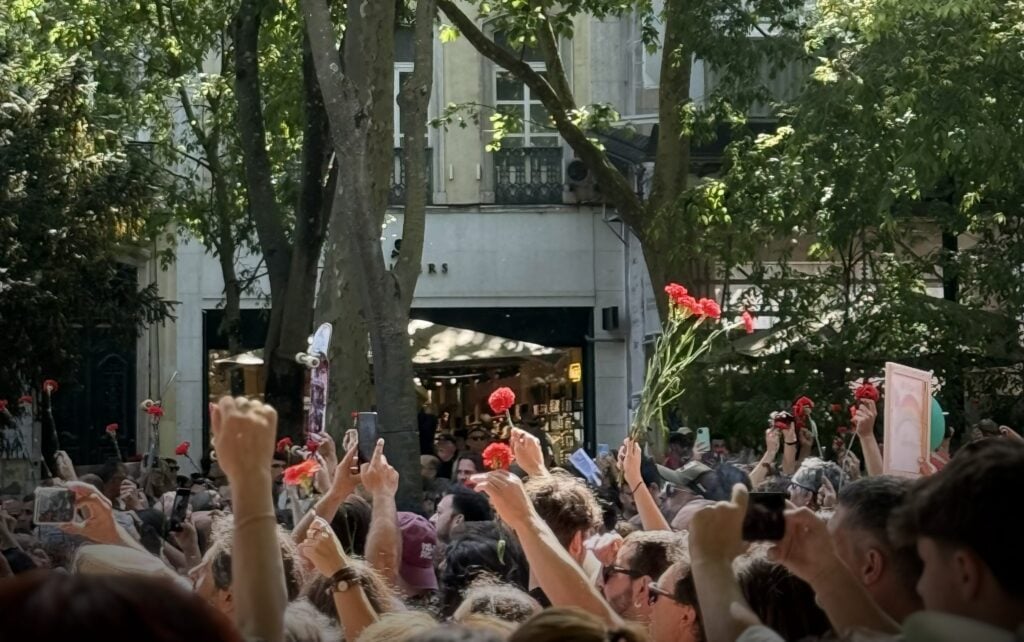
52 years ago, an American journalist at Largo do Carmo, in the heart of Lisbon, went live on the radio to describe to his incredulous listeners what his puzzled eyes were witnessing: “It’s as if people woke up feeling like birds and perched in trees,” he said. It was the morning of April 25, 1974, and what the journalist—who didn’t speak a word of Portuguese—didn’t know was that a revolution was about to usher in a new era of freedom and democracy. The military, having had enough of an unjust and brutal colonial war, had plotted a coup and ordered the people of Lisbon to stay home, but no one obeyed. Thousands gathered at Carmo, where the remnants of the government were holed up, and, sensing that something momentous was about to happen, climbed the trees.
On April 20, ULIS welcomed two guest speakers who told our students what it was like to live under a dictatorship and, perhaps more importantly, what the price of freedom was. Conceição Matos and Domingos Abrantes are a gentle-looking couple in their nineties. But appearances can be deceptive: these tougher-than-steel freedom fighters endured more than 30 years of dangerous clandestine struggle for democracy, spent 15 years in prison, resisted the most brutal forms of torture, and even married while incarcerated. Domingos escaped from a high-security prison in an audacious, action-packed challenge to the regime. They returned from exile on the famous “Plane of Freedom” when the Carnation Revolution brought an end to the longest dictatorship in Europe, and since then have become a living testament to Portugal’s resistance against oppression. It was striking to see our 10th and 11th grade students listening attentively — some with tears in their eyes — to these first-hand accounts of why the past can’t be forgotten.
Education and freedom are two sides of the same coin: without education, there can be no freedom, and without freedom, there can be no real education. That is why, at ULIS, learning history is not a sterile exercise in memorisation, but a critical reflection on historical significance; a genuine discussion of change and continuity; an engaged debate about perspectives and their evidence; and a continuous effort to establish causal links that cross borders and centuries; en exercise of democracy. History, after all, cannot teach us all the right answers, but it can certainly teach us how to ask the right questions.
Education, I would argue, is the personal equivalent of a historical revolution like: a deep, sometimes difficult, and complete transformation of oneself. In that sense, ULIS is the tree where our students perch like optimistic birds just before taking flight to shape their destinies, fulfil their dreams, and, ideally, make this world a better place.